

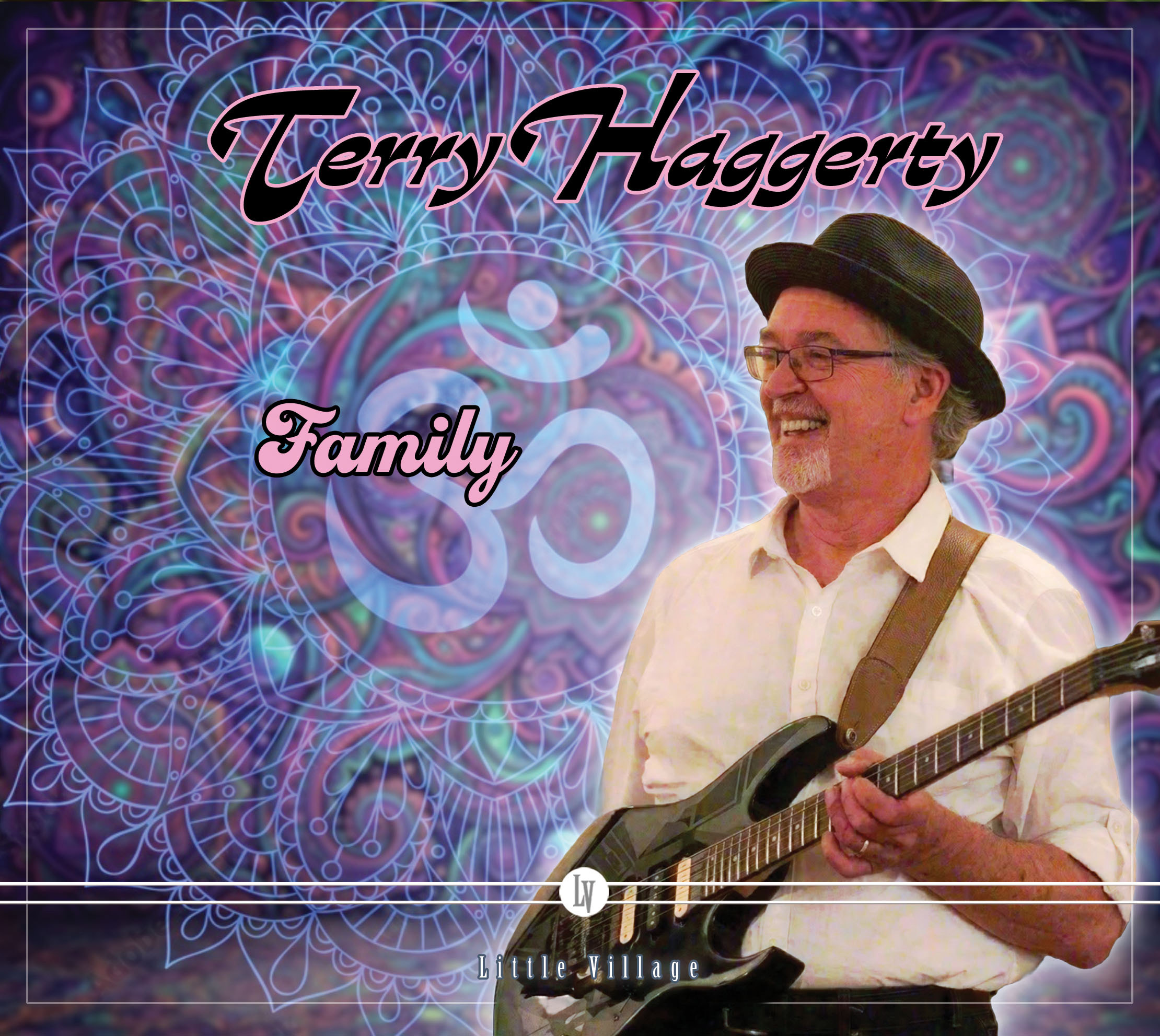
TERRY HAGGERTY – FAMILY
Terry Haggerty came to prominence as the sizzling lead guitarist of the Sons of Champlin, one of the more unusual of the groups of the San Francisco ‘60s music renaissance. Heavily influenced by R. & B. and packing a horn section, they were just slightly in the wake of the Airplane-Dead-Big Brother-Quicksilver wave, and sufficiently unusual to get less attention than they deserved, especially Terry.
His putative “rival,” Jerry Garcia, held Haggerty in high esteem. For him, Haggerty was “a unique and original player, who is highly inventive, incorporating the tone of rock and the harmonies of jazz.”
Though the Sons broke up in 1977 and resumed later in the ‘90s, Terry never stopped creating. Recently, he thought about giving his music a shape that would serve as his legacy. He and his brother Tim (keyboards) and nephew Aaron (drums) set out to review his entire musical career. Using the latest technology, they went back to songs from the past, pulled out the vocals, and redid everything in a modern context.
They were free to change anything, and did: ‘Tears of Time,” he remarked, started out in the ‘80s as a “heavy metal,” operatic cruncher and evolved into a tender ballad. There’s hints of rap (“Who Can You Trust”), a near-gospel song with reggae overtones, (“Greater Plan”), and raging rock ‘n’ roll (“Dogs R Us”).
What you have here is a sparkling set of hip R & B mixed in with three instrumentals (“Wish You Were Here,” “Latin Hags,” “New Frontiers”) that showcase his brilliant guitar chops.
His vocalists are equally brilliant: Phil Perry, whom he ‘borrowed’ from a Quincy Jones project; Mike Duke, who wrote hits for Huey Lewis & the News, and Cliff Payne, a Bay Area soul/R & B master.
This project honors his family, including his parents. His father Frank was a big band style guitarist who played with Kid Ory, Louis Armstrong, and the Dorsey Brothers. His mother was a Cuban percussionist and dancer who made sure he heard Latin music and then introduced him to masters like Armando Peraza.
In his teens, he had joined a local band called “The Opposite Six,” which included his friends Tim Caine and Bill Champlin, who was from the next town over. The Six became the Sons of Champlin by 1969. They were one of Bill Graham’s favorite bands, and Terry cherishes the memory of the time they played so well that Graham doubled their pay for the night. But drugs and internal stresses shut the Sons down in 1979.
Terry moved on to various botanical enterprises, and after his hospital stay moved into a spiritual path that led him to Buddhism. Eventually he discovered “The Living/Dying Project,” a creation of Ram Dass follower Doug Borglund, and his work with the dying is an important part of his life. You can hear the power of his spirituality in his playing, which is simply brilliant.